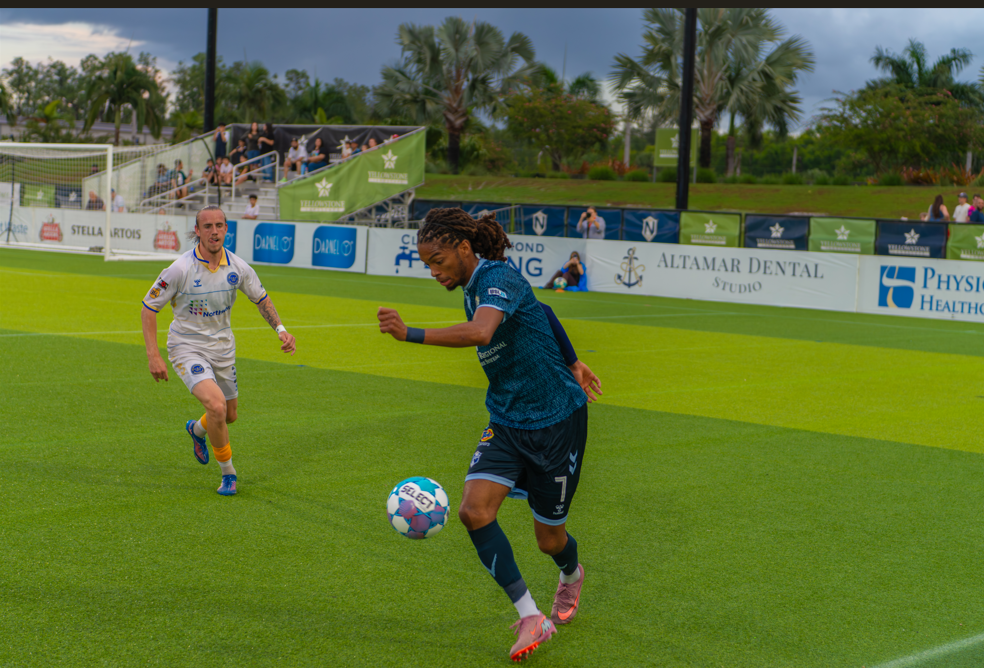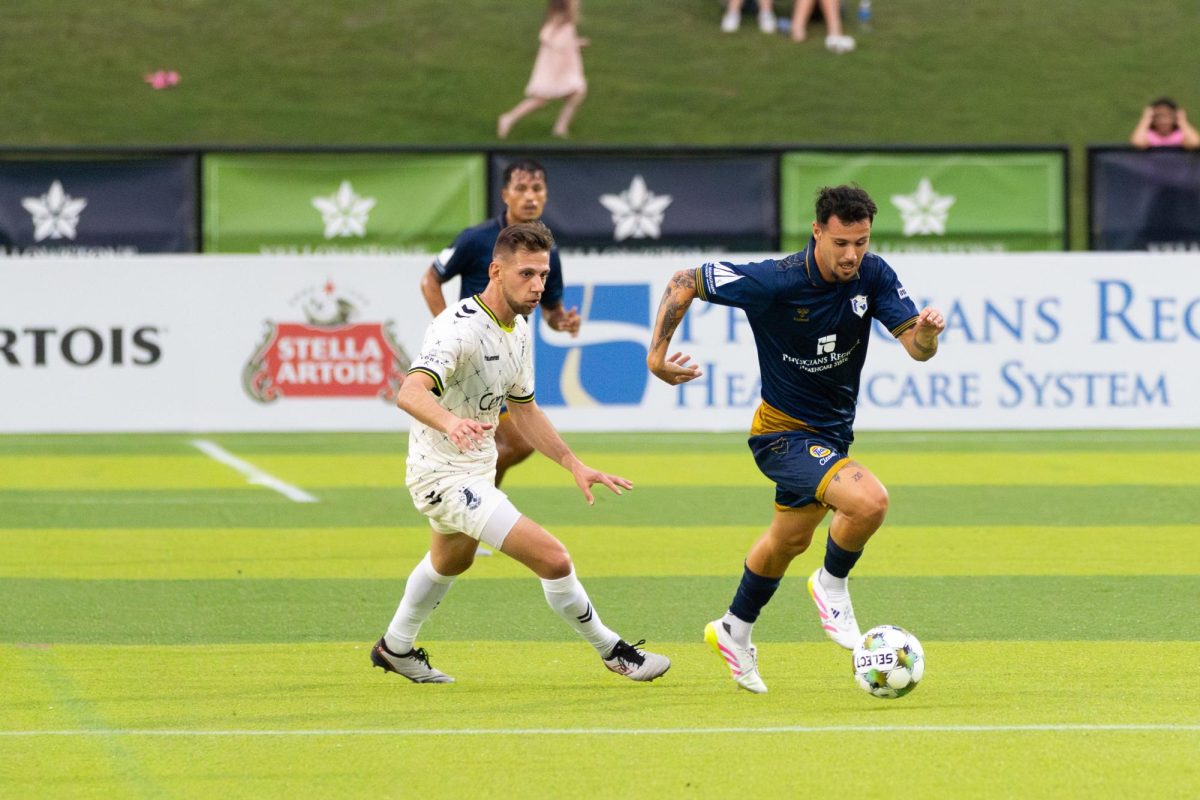









When the FGCU men’s soccer team jogged onto Pickering Field at the FGCU Soccer Complex, the warm-up drills were accompanied by a mix of English, Portuguese and Spanish.
Over the past few seasons, FGCU has built one of the most internationally influenced men’s soccer teams in the Atlantic Sun (ASUN) Conference. The Eagles have formed a distinct international identity, with a roster that combines global talent and cultural diversity.
Head coach Oliver Twelvetrees added 13 players to their 2025 roster, incorporating experienced transfers coming from various college levels. The new additions came from different countries: Brazil, America, Spain, Mexico, Sweden and Denmark. Of the 28 Eagles on the roster, 14 are from outside the United States. Twelvetrees said this approach is both strategic and intentional.
“They must have a special ability,” Twelvetrees said of international players. “We are not expecting them to be perfect, but they have to bring something that you are going to help our team, right as a player.”
For many of these athletes, adjusting to a new country while competing in Division I soccer is both challenging and transformative, pushing them to grow on and off the field. A typical training day for the team during the season involves early morning sessions with warm-ups and technical drills. Training sessions last about an hour and a half to two hours. After training, players pack up, shower, have lunch and go to class or the gym in the afternoon and evening.
The team’s international dynamic reflects the growing globalization of college athletics.
Brazilian players, in particular, have become a very important part of the Eagles’ roster construction approach. FGCU’s 2025 team had one of the biggest concentrations of Brazilian players in the last decade. Twelvetrees’ transition from Colorado State University-Pueblo to FGCU included him bringing two CSU-Pueblo Brazilian players to Fort Myers to play for the Eagles.
“I had some Brazilian players that I have worked with in the past,” Twelvetrees said. “I was able to bring them with me. So, I think that connection was really important.”
One of the players was Dylan Zavatini, a 24-year-old graduate student from Santa Catarina, Brazil. Like most international players, Zavatini mentioned challenges like language barriers at the beginning.
“When I first came, it was pretty hard,” Zavatini said. “It was pretty difficult because it was hard to immerse myself in the culture because I didn’t fully understand what people were saying.”
In addition to a language barrier, international student-athletes have to deal with academic standards, the visa process and a sense of homesickness.
However, there are also challenges on the field.
FGCU midfielder Leonardo Schorr, a 25-year old senior from Brazil, said that while the Eagles had a talented team on paper, it lacked chemistry on the pitch.
Despite the language barriers, the locker room becomes a cultural melting pot.
“Probably the joy that we bring every day, dancing, singing, saying out loud,” Schorr said of what makes the FGCU locker room special. “It might bother the others sometimes, but I think that if they look at us, they will see that we’re happy, laughing all the time and bring a good energy for the team every day.”
The Eagles finished the 2025 regular season with an overall record of 6-7-3 and a conference record of 2-3-1. FGCU’s regular season came to an end after a 2-1 loss to Jacksonville on Nov. 2.
“I think we could have achieved more,” Twelvetrees said of his first season. “I think this first year was a good learning lesson for the team, you always have to be at your very best. The standard is really high, and it is very difficult to win in Division I, but we are on a good path.”